
Canva's co-founder Cliff Obrecht had to address this publicly: is Canva's $60 billion private valuation still justified?
The question tells you everything about where design software is heading — and why small businesses that have built their creative stack on Canva should be paying attention.
What Google Stitch Actually Is
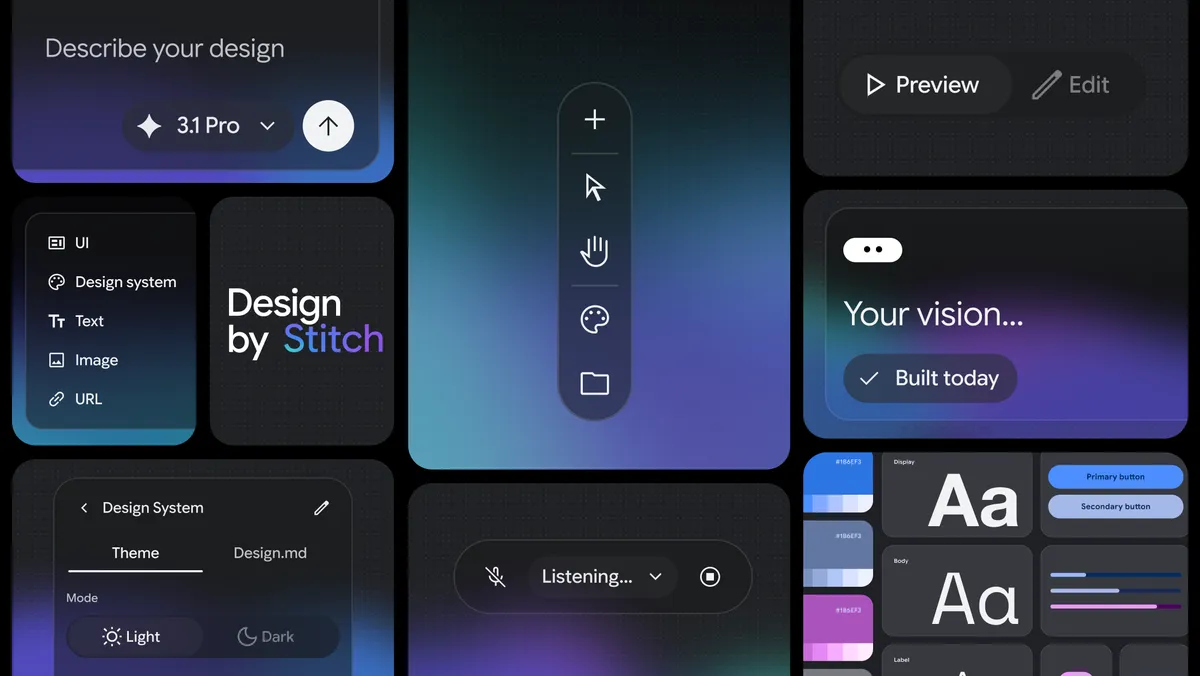
Stitch isn't a Canva clone. You describe what you want and the tool generates it from scratch.
The March 2026 update added an infinite canvas, voice interaction, and integration with coding assistants including Claude Code and Cursor. Google calls the new paradigm "vibe design": instead of placing elements on a template, you describe a business objective, a feeling, a reference, and Stitch generates multiple design directions. 350 free generations per month. Powered by Gemini.
Stitch is currently aimed at UI/UX designers building app interfaces. But the underlying technology is the same logic that will reshape every creative tool over the next years.
Why Canva is under pressure
In February 2026, Canva reported $4 billion in annual recurring revenue, 265 million monthly active users, and 35% year-over-year growth. Its B2B business doubled, reaching $500 million in ARR.
But the competitive pressure is real: Canva was built as a template tool that added AI on top. Google Stitch — and a growing category of AI platforms — were built the other way around. AI is the foundation, not the add-on.
Canva knows this. The company is actively repositioning itself from "a design platform with AI tools" to "an AI platform with design tools". It acquired MangoAI and Cavalry, built its own foundational design AI model, and launched integrations with ChatGPT that generated over 26 million user conversations by October 2025.
That's a significant pivot for a company at $4B ARR. And pivots at scale are slow, expensive, and uncertain.
This isn't the first time a dominant platform has been disrupted by a category shift it didn't initiate.
Microsoft Office dominated productivity software for two decades. Google Docs didn't beat it by being a better Word — it changed the paradigm to browser-based, real-time collaboration, and captured an entirely new generation of users.
Canva did the same thing to Adobe. Adobe required professional training, expensive subscriptions and desktop software. Canva made design accessible to people who were never going to learn Photoshop.
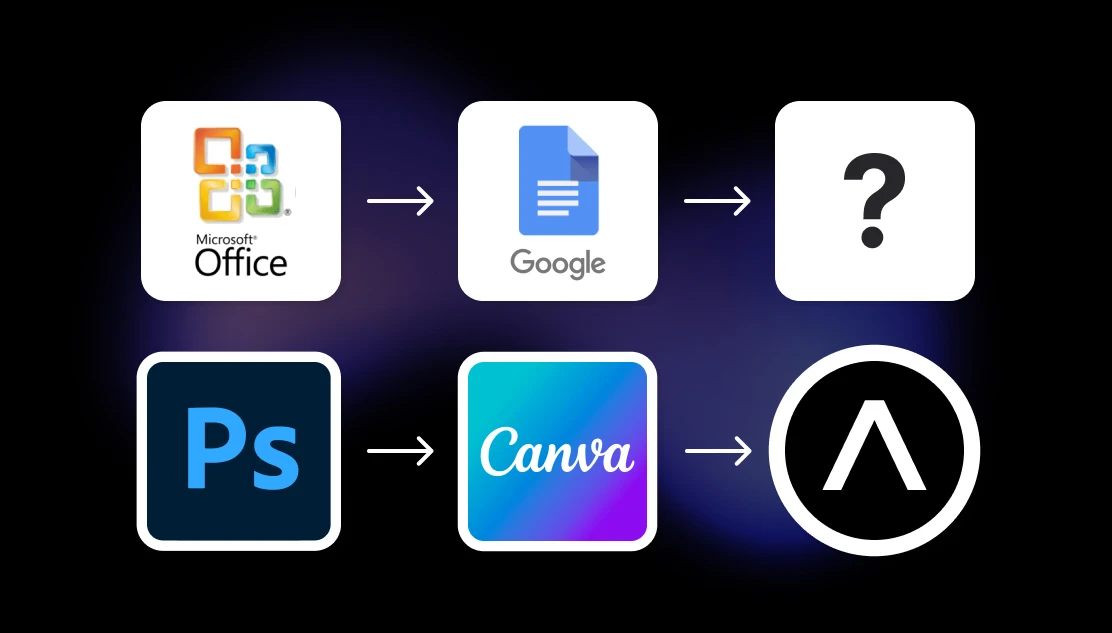
Now the floor is being lowered again. Not just to "drag and drop without design skills" — but to "describe what you want in plain language and get the output." That's a different category of accessible. And it's the direction every serious creative platform is moving.
What this means if you're a small business
If you run a small business, an e-commerce store or a creative agency and you've built your workflow around Canva, this moment is worth pausing on — not to panic, but to understand what's actually happening in the market.
The template model has a ceiling. Canva's core value proposition is that you start from a template and customize it. That works well for consistent, recurring content — social media posts, presentations, basic marketing materials. But it starts to break down when you need original, specific, high-volume creative output: product photography, AI-generated models, video content, virtual staging for real estate listings, custom audio.
Credit limits are a real constraint. Canva Pro gives you 500 AI credits per month. That sounds like a lot until you're producing a product catalog, generating variations for A/B testing, or trying to create a week's worth of social video. Once the credits run out, you're back to templates. AI-native platforms don't work this way — generation is the product, not a monthly allowance.
The stack fragmentation problem is getting worse. Most small businesses that rely on Canva don't only use Canva. They use Canva for design, then a separate tool for video, another for music or voiceover, another for product photos, another for background removal. Each tool has its own subscription, its own learning curve, its own file formats. The real cost of a Canva-centered creative stack — once you've added what Canva can't do — often reaches $80–100/month across five or six platforms.
AI-native tools consolidate that. Not because they're cheaper by default, but because they're built to handle the full production pipeline in one place. Video, image, audio, music, product photography, marketing assets — without switching apps, exporting files, or re-learning interfaces.
Canva's $60 billion valuation is defensible if you believe the company can successfully transition from a template platform to an AI platform fast enough to stay ahead of Google, Adobe, and a growing field of AI-native tools.
That's not a crazy bet. Canva has the users, revenue, brand recognition, and the distribution. And LLMs are already referring users directly to Canva.
But can Canva retrain 265 million users to think of it as an AI platform before those users discover that AI-native alternatives exist?
Can it ship AI generation quality that competes with purpose-built tools in video, product photography, fashion, and audio? Can it open up its API for developers, which it currently doesn't do?
Those are open questions. And for small businesses, they matter — because the platform you build your creative workflow on today will determine how much you have to migrate, re-learn, and rebuild if that platform doesn't make the transition successfully.
If your creative needs are growing, it's worth asking whether the tool you're relying on was built for the world you're operating in now, or the world from five years ago.
The platforms built around AI generation from the ground up, like Artificial Studio, are gaining ground. And for small businesses, the window to build on the right foundation — instead of adding workarounds on top of the wrong one — is open right now.
Artificial Studio is an AI-native creative platform with 50+ tools for video, image, audio, product photography, fashion, virtual staging, and marketing — built from the ground up for teams that need creative output at scale, not templates.
Sources