Unified AI API vs multiple AI providers: pros, cons, and hidden costs
As businesses scale up their use of AI, a key architectural question arises: Should you integrate multiple specialized AI providers individually, or adopt a unified API that brings all capabilities together?
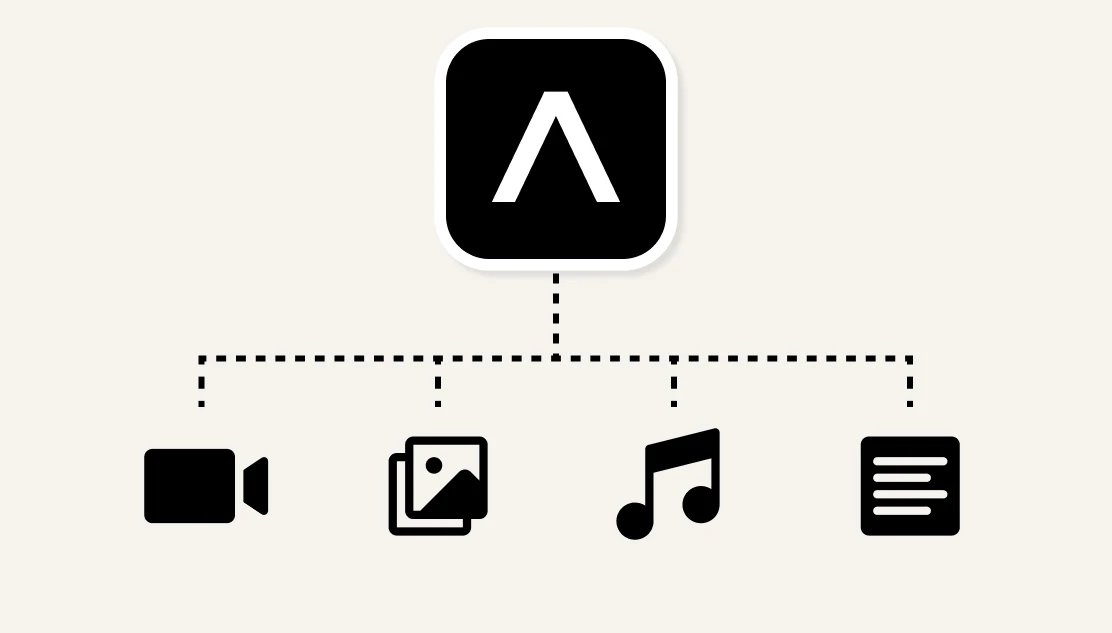
This isn’t just a technical choice, it’s a strategic decision that impacts development velocity, operational complexity, cost, and long-term innovation.
In this article, we’ll explore the trade-offs between these two approaches and explain why a unified AI API strategy is increasingly compelling for modern products.
Why the Question Matters
Platforms can generate stunning visuals, engaging videos, lifelike audio, 3D assets, and much more with AI. In fact, solutions like Artificial Studio offer more than 50 AI tools covering video, image, music, branding, 3D design, and creative extras — all in one ecosystem!
However, most of these capabilities originate from distinct underlying technologies: different models, APIs, and provider ecosystems. Without a unified interface, developers must juggle multiple integrations, each with unique authentication, billing, and payload semantics. This fragmentation introduces both hidden costs and operational friction.
What the multiple AI providers approach looks like
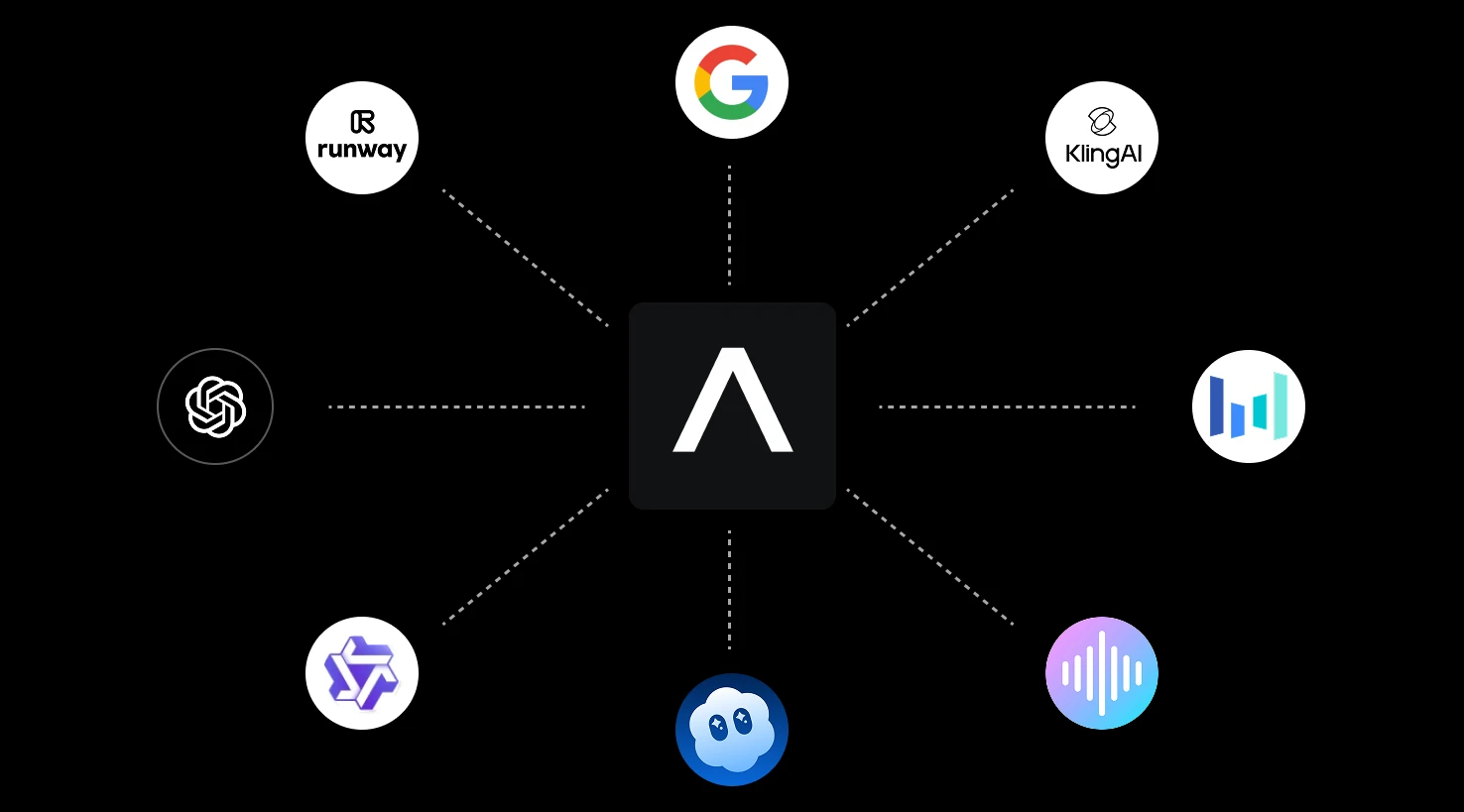
A product team chooses several best-in-class AI solutions and integrates them separately. For example:
- One provider for image generation
- Another for video
- A different API for text-to-speech
- Yet another for segmentation or 3D output
Each endpoint serves a particular task, often with tailored documentation and SDKs.
Pros: Flexibility in picking best-in-class models. You can theoretically cherry-pick the top tool for each use case. Incremental experimentation: teams can incrementally test providers before committing.
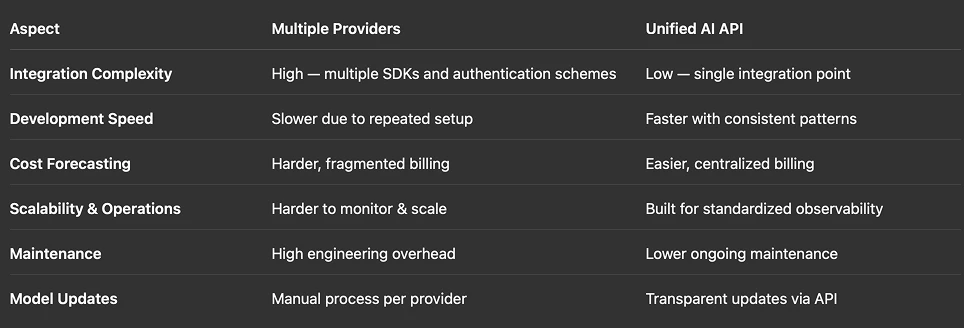
Cons: That flexibility comes at a cost. Operational complexity, each provider means a new API key, rate limits, error handling patterns, and billing structure. Managing them all consistently becomes a non-trivial burden, especially at scale. Hidden financial costs: Siloed usage metrics across providers make it harder to forecast spend and optimize costs. Inconsistent developer experience: Different data formats and authentication schemes slow down integration and make on-boarding new developers harder. Scaling challenges, as traffic grows, disparate systems make observability, fallback logic, performance monitoring, and governance much more complex.
The Unified AI API Model
A unified AI API brings multiple generative capabilities (text, images, video, audio, 3D, editing tools) under a single integration point. Platforms like Artificial Studio offer this approach, providing API access to a broad suite of powerful content generation tools via one consistent interface.
Core Advantages
1. Reduced Integration Overhead: When you integrate through a unified API, you’re working with one authentication scheme, one billing relationship, and one set of SDKs. That’s a dramatic reduction in upfront work and ongoing engineering maintenance.
💡 This level of abstraction lets teams ship faster without reinventing the wheel for each AI capability.
2. Consistent Developer Experience: Unified APIs standardize request and response formats across media types — text, visuals, sound, animation — making it simpler for developers to reason about AI calls and build consistent client libraries, regardless of the backend model powering the result.
3. Simplified Cost Management: With multiple providers, you juggle credits, quotas, and billing tiers. Unified APIs often consolidate billing into a single dashboard and usage model, giving teams clearer visibility into costs and easier optimization.
4. Easier Future-Proofing: AI models and technologies evolve rapidly. With a unified layer, the API provider can swap underlying models, update capabilities, or optimize performance transparently to your application. You benefit from innovation without continuous re-engineering on your side.
Pros & Cons side by side
Hidden Costs You’re Likely Missing: developers focused on immediate functionality often overlook
- Time spent writing and maintaining adapter layers for each provider
- Engineering cycles for error handling and retry logic
- Cost leakage through unused or orphaned API keys
- Security governance complexity across multiple access tokens
When a unified API makes sense
A unified AI API strategy is especially valuable when:
- You need multiple generative capabilities (e.g., images + video + audio)
- Your product roadmap spans diverse AI tasks over time
- You have cross-functional teams relying on shared AI infrastructure
- You’re optimizing for developer efficiency and cost predictability
From an implementation standpoint, a unified AI API typically abstracts multiple generation capabilities behind a consistent request structure. Instead of learning separate payloads for text, image, video, or audio generation, developers work with a shared interface and adapt only a few parameters depending on the output type.
In practice, this often means: one authentication flow, a small number of core endpoints and predictable request and response formats across tools
Teams adopting this approach usually start with a simple proof of concept — for example, generating an image or short video from text — and then expand to more advanced use cases over time.
👉 Platforms like Artificial Studio provide a clear entry point for this kind of experimentation, in this link you can see a concise Quick Start guide that shows how to make a first API call in minutes, without committing to a full integration upfront.
This makes unified APIs especially attractive for teams that want to validate ideas quickly while keeping their architecture flexible for future expansion.
Both approaches have their place, but the future of AI-driven products is increasingly unified. The tooling landscape — from content creation workflows to API ecosystems — is moving toward composable, interoperable, and scalable platforms that minimize operational friction.
Choosing a unified AI API lets your team spend less time wrestling with integrations and more time building value into your product. Platforms like Artificial Studio demonstrate how a broad suite of tools — accessible via one API — can unlock capabilities without the complexity of traditional multi-vendor setups.