How to Make AI-Generated Content Look Human
Text that sounds too polished. Images that feel oddly generic. Videos that look impressive at first glance but somehow lack soul. Most people struggle to make the AI content feel real.
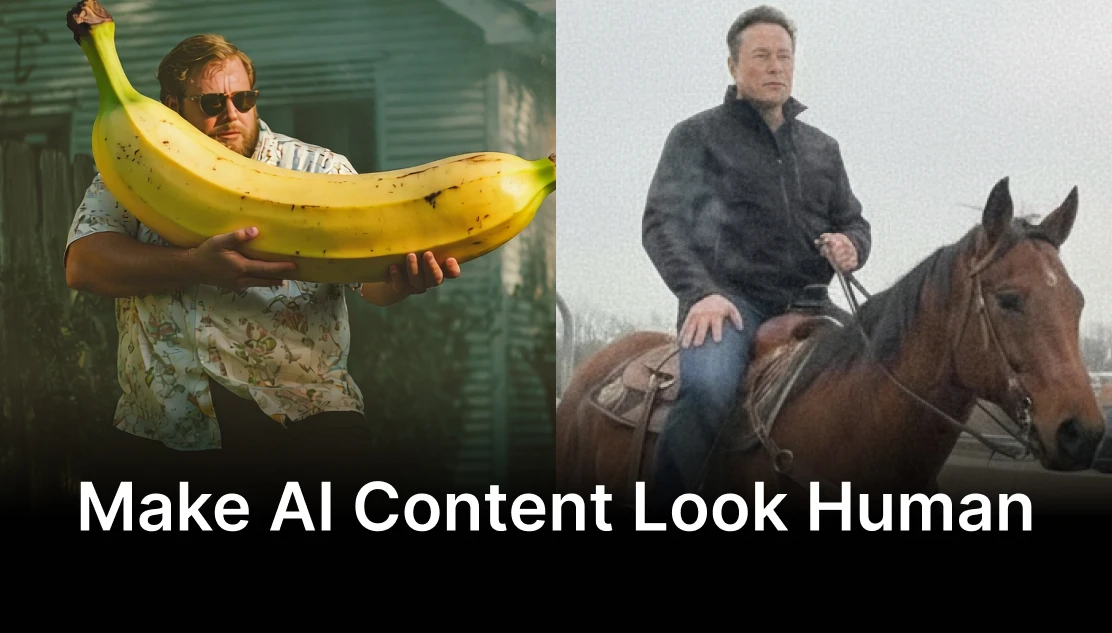
If you’ve ever thought “this looks good, but it doesn’t feel human” the solution isn’t adding more tools to your stack. It’s understanding why AI content feels artificial in the first place, and how to design around those limitations, and prompt better!
Humans communicate with inconsistencies. Artificial Intelligence by default, does the opposite. It smooths everything out. It averages ideas. It removes friction — which ironically removes believability.
When content feels “robotic,” it’s usually because everything is too symmetrical, nothing feels intentional and the output tries to please everyone.
Here is an example of a prompt that created this realistic photo:
“Ultra realistic editorial close up portrait of a woman of 55 years, RAW unedited photograph, realistic skin texture, visible pores, micro-creases, peach-fuzz hairs, natural skin sheen, subtle reddish cast, soft dryness on lips, natural eyelash clustering, natural imperfections, golden hour daylight”

Human work is never perfectly balanced. A sentence runs longer than expected, a visual composition breaks the grid slightly. AI tends to eliminate those micro-frictions.
The goal isn’t to make content worse — it’s to make it believable.
One of the biggest mistakes people make is asking AI to do everything. Human-looking content usually comes from direction, not delegation.
Instead of: “Write a perfect blog post about X”
Try thinking in terms of structure first, intention second and generation third
AI should support the process, not define it. When you decide what matters before generation, the output instantly feels more grounded. This applies to copywriting, image generation and video workflows
Instead of generic prompts like:
- “a modern office”
- “a professional tone”
- “a cinematic shot”
Human results come from constraints:
- a specific place
- a clear audience
- a real use case
- an emotional goal
Here is another example of a prompt that created this realistic photo:
“Extreme close-up portrait of a woman emerging from dark water, only eyes and upper face visible above the surface, intense gaze, braided wet hair with defined baby hairs, water droplets glistening on skin, moody natural lighting, shallow depth of field, soft ripples around the face, dramatic tension, hyperrealistic texture, cinematic atmosphere, muted color palette, high-detail photorealism, emotional and mysterious tone”

This is especially noticeable in visual AI. Models designed for realism, like Nano Banana Pro, perform best when they’re guided by concrete context instead of abstract adjectives.
One subtle detail most AI content misses: rest. Humans don’t fill every second, don’t answer every question, they let things imply.
To humanize AI-generated content:
- remove unnecessary explanations
- cut instead of adding
- allow ambiguity when it makes sense
- trust the audience
Ironically, the more confident the content feels, the less it tries to prove itself.
If you’re building systems where AI content needs to scale without losing credibility, having programmatic control through APIs becomes essential. (That’s where solutions like our API come into play — not for creativity, but for consistency.)
The goal isn’t to hide the fact that AI was used. The goal is to make the result feel intentional.
Human content isn’t defined by mistakes — it’s defined by choices. When AI-generated content reflects clear decisions, boundaries, and purpose, people stop asking “Was this made by AI?” and start focusing on the message itself.
And that’s when AI stops feeling artificial — and starts feeling useful.