The State of AI in 2026: insights from Stanford's Index report
Stanford's 2026 AI Index Report decoded: key findings on adoption, investment, jobs, and what it means for creative professionals and businesses.
Every year, Stanford University's Human-Centered AI Institute publishes the AI Index Report — the most comprehensive, independently sourced analysis of artificial intelligence available.
The 2026 edition covers everything from investment and adoption to jobs, education, public opinion, and the gap between what AI can do and what the systems around it can handle.
Here are the findings that matter most:
AI is not slowing down. It's accelerating 🌪️
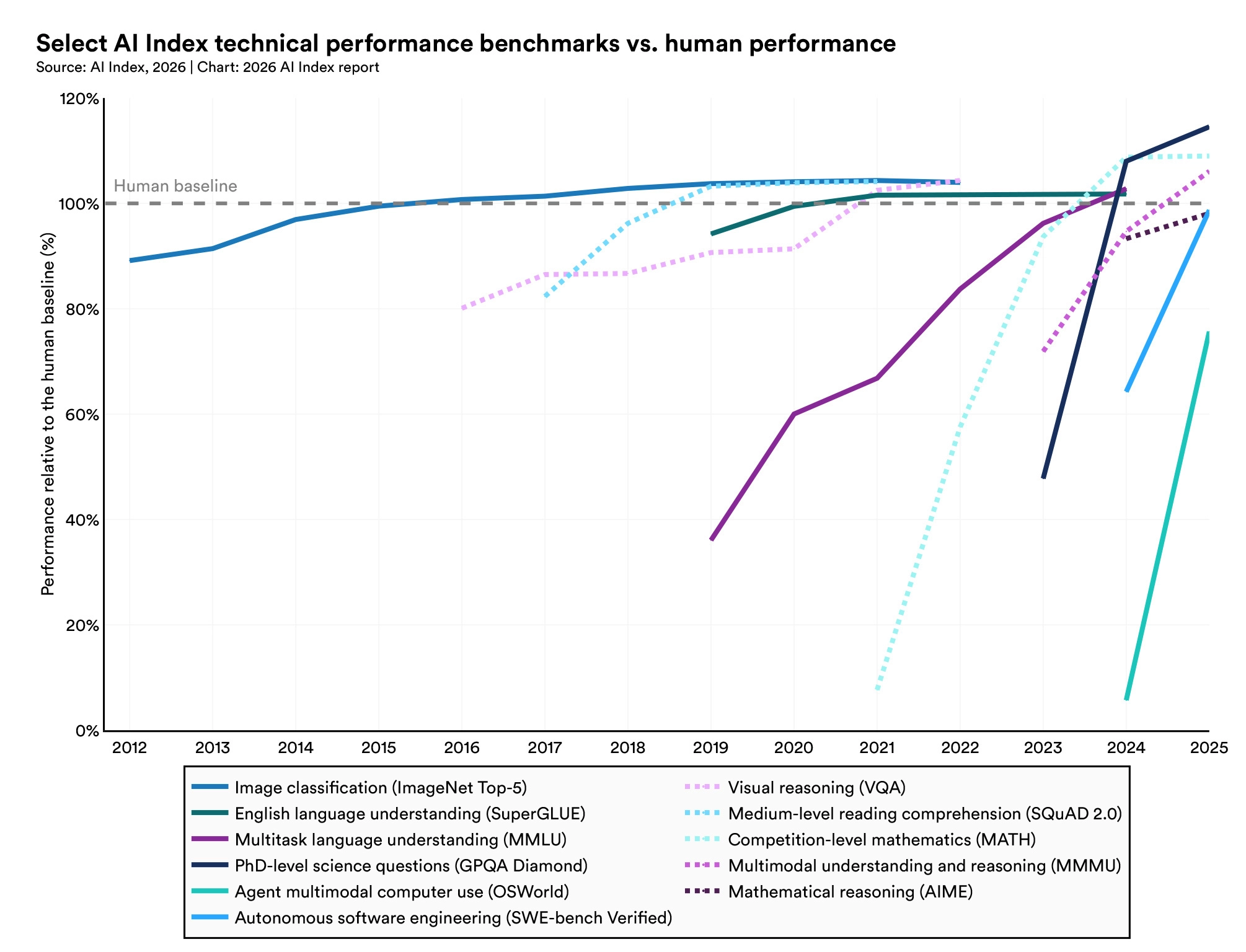
Industry produced over 90% of notable frontier AI models in 2025. Several of those models now meet or exceed human performance on PhD-level science questions, multimodal reasoning, and competition mathematics. On a key coding benchmark — SWE-bench Verified — performance rose from 60% to near 100% of the human baseline in a single year.
Organizational adoption reached 88% of surveyed companies. Four in five university students now use generative AI.
💡 It is not slowing down, in fact, the distance between the technology's capabilities and most people's understanding of it is growing.
AI's labor market effects are showing up unevenly 💼
The labor market picture is nuanced and worth reading carefully.
Employment for software developers ages 22 to 25 fell nearly 20% from 2024, even as headcount for older developers continues to grow. The impact is concentrated in entry-level roles in AI-exposed occupations — not across the board.
One-third of surveyed organizations expect AI to reduce their workforce in the coming year, with anticipated reductions highest in service operations, supply chain, and software engineering. However, large-scale job losses have not yet shown up in overall employment data.
AI experts and the U.S. public have very different views on this. When asked whether AI will have a positive impact on how people do their jobs, 73% of experts said yes — compared to only 23% of the general public, a 50-point gap. Similar divides appear for the economy (69% vs. 21%) and medical care (84% vs. 44%).
Nearly two-thirds of Americans (64%) expect AI to lead to fewer jobs over the next 20 years. Experts are less pessimistic — 39% predict fewer jobs, 19% predict more — and they forecast far faster adoption, expecting generative AI to assist 80% of U.S. work hours by 2030, compared to the public's estimate of 10%.
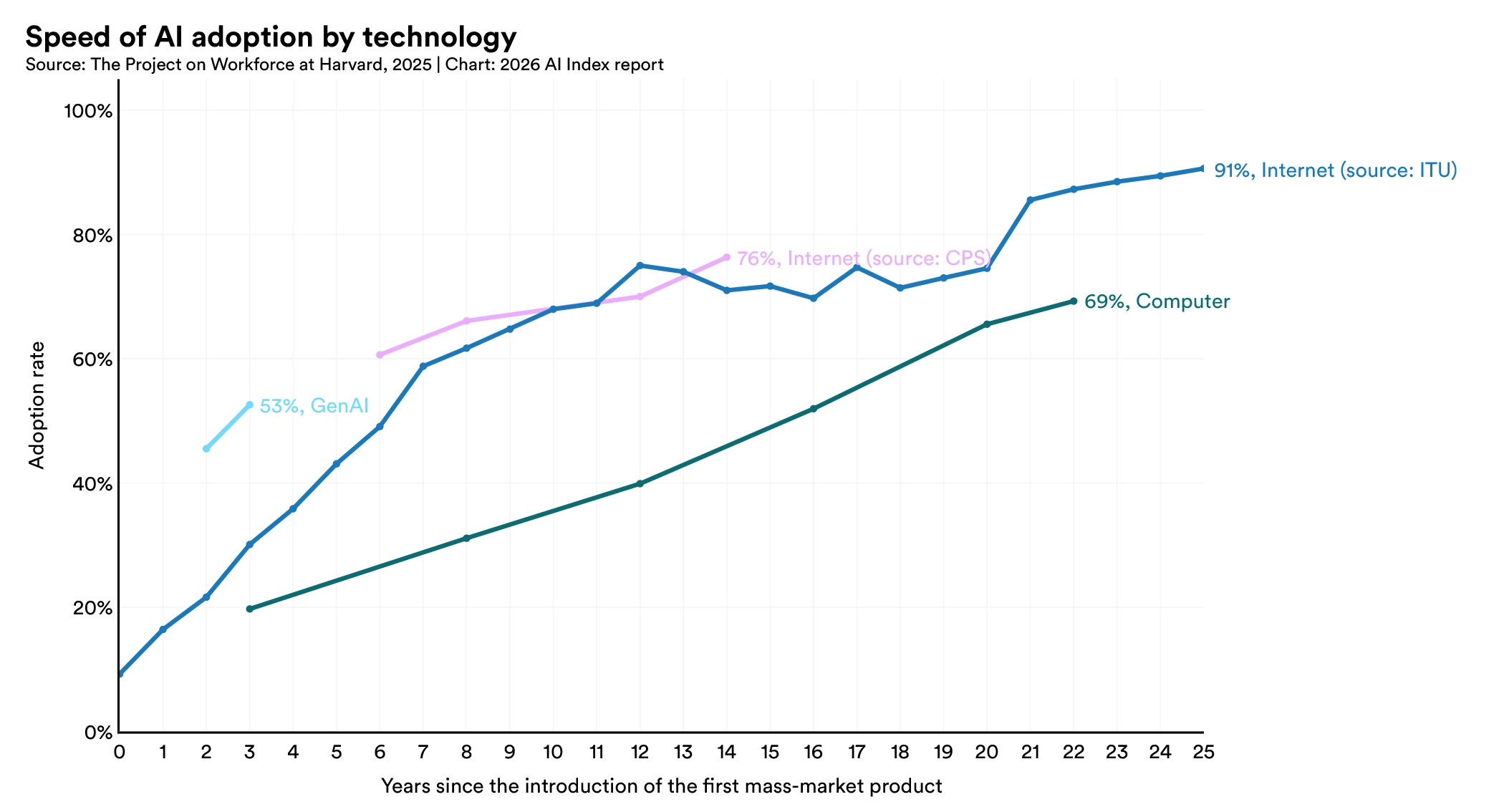
Generative AI reached mass adoption faster than the PC or the internet
💡 Generative AI hit approximately 53% population-level adoption within three years of its mass-market introduction.
The value consumers are getting from it is growing fast too. Estimated U.S. consumer surplus from generative AI tools reached $172 billion annually by early 2026 — up from $112 billion a year earlier. The median value per user tripled over that same period. Most of these tools remain free or close to it.
Global AI investment more than doubled in 2025 💰
Global corporate AI investment reached $581.69 billion in 2025 — a 129.9% increase from the previous year. Private investment alone grew 127.5% to $344.7 billion. Generative AI accounted for nearly half of all private AI funding, growing over 200% from 2024.
The number of newly funded AI companies rose 71%, and billion-dollar funding events nearly doubled (from 15 to 28).
💡 The United States remains the dominant force, with $285.9 billion in private AI investment — 23 times more than China ($12.4 billion) and 48 times more than the United Kingdom ($5.9 billion). In generative AI specifically, U.S. investment exceeded the combined total of China and Europe by a wide margin.
A few notable milestones from 2025: OpenAI raised $40 billion at a $300 billion valuation. Nvidia became the first public company worth $4 trillion. Anthropic raised $13 billion at a $183 billion valuation. The Stargate Project — a joint venture between OpenAI, SoftBank, Oracle, and MGX — announced plans to invest between $100 billion and $500 billion in AI data centers in the U.S. by 2029.
The U.S.-China AI gap has effectively closed at the model level 🇺🇸🇨🇳
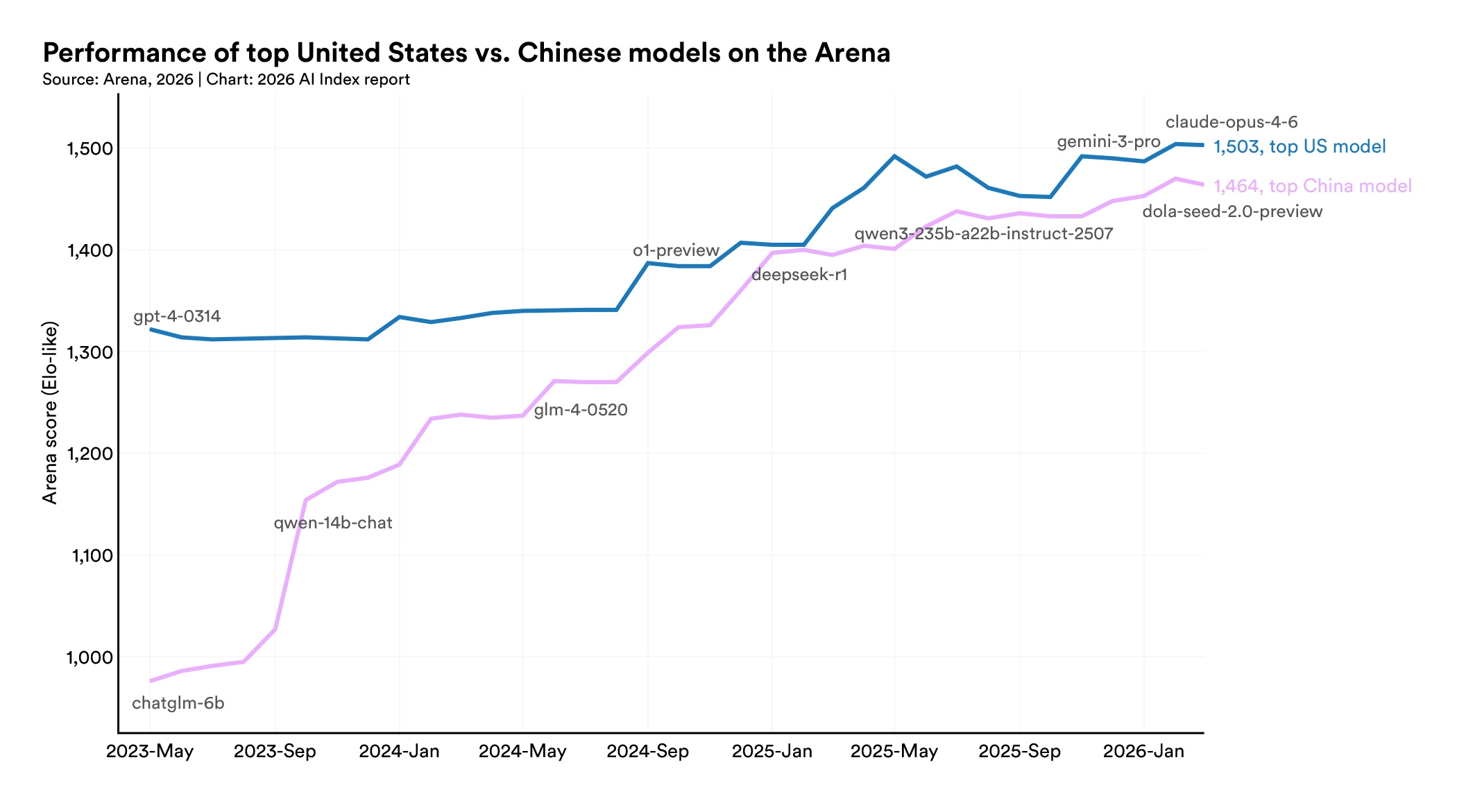
While the United States still leads in private investment and produces more top-tier AI models (50 notable models in 2025 vs. China's 30), the performance gap between U.S. and Chinese models has effectively closed.
U.S. and Chinese models have traded the lead multiple times since early 2025. In February 2025, DeepSeek-R1 briefly matched the top U.S. model. As of March 2026, Anthropic's top model leads by just 2.7%. China leads in publication volume, citations, patent output, and industrial robot installations. South Korea stands out for innovation density, leading the world in AI patents per capita.
One important caveat: China's government has deployed an estimated $184 billion in state-backed guidance funds into AI firms since 2000, which means private investment comparisons likely understate China's total AI spending.
AI has a "jagged frontier" problem
One of the most useful concepts from this report is what researchers call the jagged frontier of AI: models that can solve extraordinarily complex problems while failing at surprisingly simple ones.
Gemini Deep Think earned a gold medal at the International Mathematical Olympiad. Yet the top AI model reads analog clocks correctly only 50.1% of the time. AI agents jumped from 12% to ~66% task success on OSWorld (which tests real computer tasks), but still fail roughly 1 in 3 attempts on structured benchmarks.
This pattern matters for anyone building with or on top of AI: the capability profile of these models is uneven in ways that are not always predictable. Knowing what a model does well is only half the picture.
Productivity gains are real — but concentrated in specific types of work 📈
The report documents measurable productivity gains from AI, but they are not uniform. The clearest gains appear in structured, measurable work where outputs are easy to monitor: 14–15% in customer support, 26% in software development, 50% in marketing output.
Gains are smaller and sometimes negative in tasks requiring deeper reasoning or judgment. There is also emerging evidence that heavy AI reliance may carry long-term learning penalties that slow skill development over time.
💡 For creative and marketing work specifically, the productivity signal is strong. The 50% gain in marketing output is one of the highest documented across any sector in the report.
Responsible AI is not keeping pace with capability
Almost all leading AI model developers report results on capability benchmarks. Reporting on responsible AI benchmarks remains spotty. Documented AI incidents rose to 362 in 2025, up from 233 in 2024.
There is also a fundamental tension: recent research found that improving one responsible AI dimension, such as safety, can degrade another, such as accuracy. This is not a solved problem.
The most capable models are also the least transparent. Training code, parameter counts, dataset sizes, and training duration are no longer disclosed for several of the most resource-intensive systems, including those from OpenAI, Anthropic, and Google.
AI is transforming science and medicine — but the evidence base is still thin in clinical settings 🧪
In science, frontier models now outperform human chemists on average on ChemBench. A 111-million-parameter protein language model beat previous leading methods on ProteinGym. Most AI foundation models for science come from cross-sector collaborations, in contrast with the industry-dominated general-purpose AI landscape.
**In medicine, AI tools that automatically generate clinical notes from patient visits saw substantial adoption in 2025. **Physicians reported up to 83% less time spent writing notes and significant reductions in burnout. But a review of more than 500 clinical AI studies found that nearly half relied on exam-style questions rather than real patient data, with only 5% using real clinical data. The evidence base remains thin.
People are using AI more at work, but trust in institutions to manage it is fragmented
Globally, 58% of employees reported using AI on a semiregular or regular basis in 2025. In India, China, Nigeria, the UAE, and Saudi Arabia, over 80% reported regular use. In most North American and European countries, regular use sits between 40% and 48%.
Global optimism about AI rose — 59% of respondents now say AI products have more benefits than drawbacks, up from 55% in 2024 — but nervousness also increased, reaching 52%.
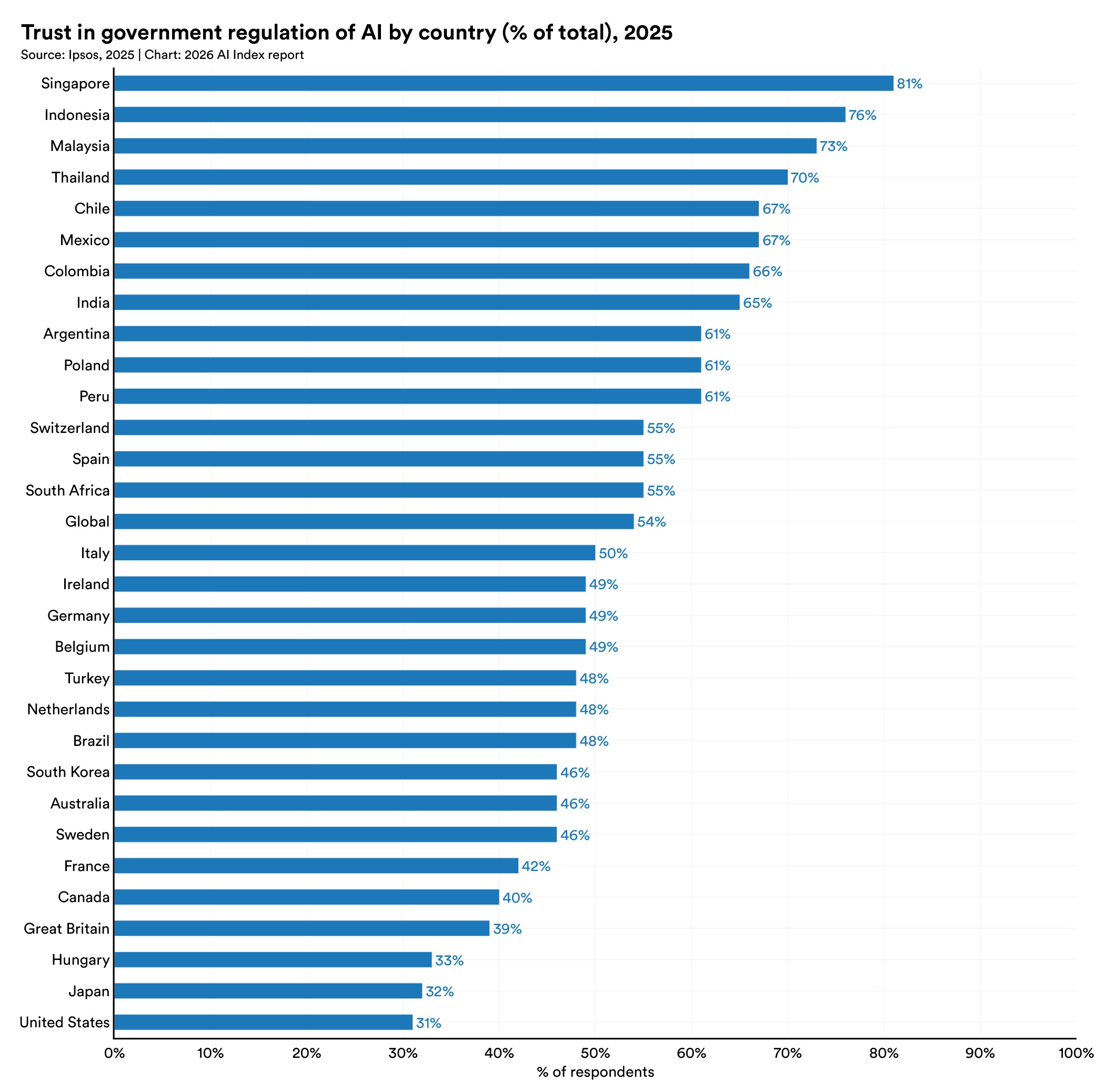
💡 The United States reported the lowest level of trust in its own government to regulate AI of any country surveyed, at 31%. The global average was 54%. The EU is trusted more than either the U.S. or China to regulate AI effectively.
What this means for creative professionals and businesses
The Stanford AI Index 2026 confirms what many in creative industries are already experiencing on the ground: AI is not a future technology. It is a present one, with measurable productivity gains and clear business value — particularly in marketing, content production, and visual creation.
The 50% productivity gain documented in marketing output is not a projection. It is a current data point from organizations that have already integrated AI into their creative workflows. The consumer value of generative AI tools tripled per user in a single year.
💡 Organizations that are still "evaluating" AI adoption are already behind the 88% that have moved forward.
The tools are accessible, the costs are low, and the gap between those who use them and those who don't is widening every month.
The report's conclusion is clear: AI is scaling faster than the systems around it can adapt. The question is whether your workflow is one of the systems adapting — or one being left behind.
Your competitors are already using AI. Artificial Studio puts video, image, audio, 3D, and design generation in one platform, so you can move faster and produce more!